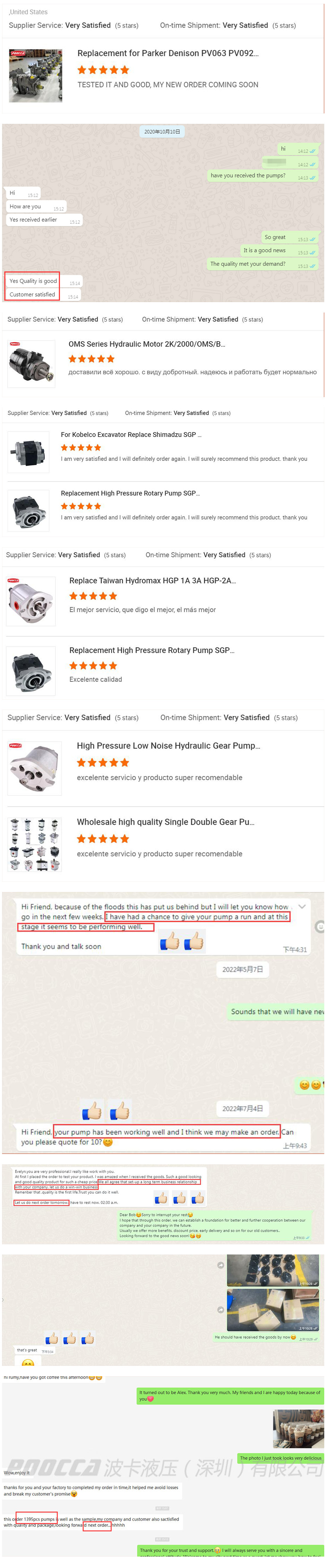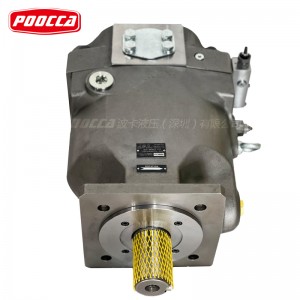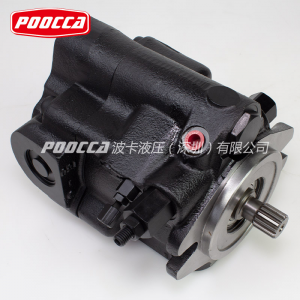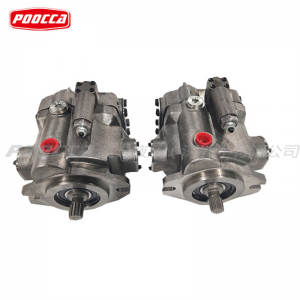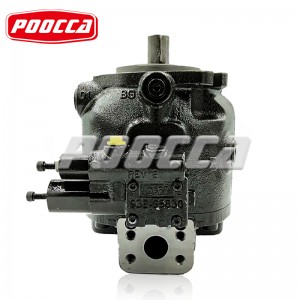
PV Series Variable Displacement Axial Piston Pump


PV016 technical specifications
The table uses Parker catalogue HY30-3245/UK, 2015 edition, for the reference code PV016R1K1T1NMF1. It combines the frame 1 data, the metric K mounting drawing and the MF1 control description. The general pump drawing uses a standard pressure compensator, so use the separate MF1 control drawing to check clearance around the top interface and the load-sense connection.
| Parameter | Parker catalogue reference |
|---|---|
| Original Part Number | PV016R1K1T1NMF1 |
| Model Designation | PV016 (PVplus, frame size 1) |
| Pump Type | Variable-displacement swashplate axial piston pump |
| Displacement | 16 cm³/rev at maximum displacement |
| Rotation | Clockwise when viewed from the shaft end (R) |
| Maximum Working Pressure | 350 bar nominal working pressure (catalogue reference) |
| Mounting | Four-hole metric flange (K), ISO 3019-2, Ø100 mm pilot (h8) |
| Suction Connection | ISO 6162 inlet flange (S), DN32 PN250, four M10 tapped holes, 18 mm deep |
| Pressure Connection | ISO 6162 outlet flange (P), DN19 PN400, four M10 tapped holes, 18 mm deep |
| Original Pump Weight | 19 kg (catalogue reference) |
| Application | Open-circuit industrial hydraulics, such as hydraulic power units and presses |
To size the pump, start with required flow at working pressure and the speed available from the drive. Multiply displacement in cm³/rev by speed in rpm and divide by 1,000 to estimate theoretical flow in L/min. Actual delivery falls with volumetric losses and changes with pressure, speed, viscosity and wear. If a circuit needs 24 L/min at its normal working pressure, share that requirement when you request a quote so the selection can account for those losses.
Review the drive and the plumbing at the same time. Confirm that the motor can supply the required shaft power at your duty point, that the inlet remains adequately supplied, and that the case drain can return oil without excessive backpressure. If the pump must run at very low speed on a variable-frequency drive, provide the full speed range and operating cycle so the quoted unit can be checked against its approved limits.
Model code, displacement options and replacement matching
Send the entire nameplate code, including suffixes or a separate compensator label. The displacement code identifies the pump size, while the rest of the code determines the mechanical interface, seal package and how the pump responds to the circuit.
| Segment | What it identifies |
|---|---|
| PV | Variable-displacement axial piston pump family |
| 016 | 16 cm³/rev maximum displacement, frame 1 |
| R | Clockwise rotation viewed from the shaft end |
| 1 after R | Standard pump variation |
| K | Metric four-hole Ø100 mm mounting interface and cylindrical keyed drive shaft |
| 1 after K | BSPP auxiliary ports and metric mounting and connection threads |
| T | Single pump prepared for through-drive, without a second-pump adapter |
| 1 after T | Single-pump build without a rear through-drive coupling |
| N | NBR seals and FKM shaft seal |
| MF | Load-sensing flow control with integrated pilot |
| Final 1 | Top NG6 interface for pilot valves |
MF1 and PVCMAMCN1 identify different controls. Parker identifies PVCMAMCN1 as an MMC standard pressure compensator for PV016–PV046. The pump reference PV016R1K1T1NMF1 specifies MF1 load sensing. If your purchase order, nameplate or photos show both, send both identifiers and tell us whether the machine has a load-sense line. We will review the pump assembly and the compensator as separate items before quoting.
For a potential aftermarket replacement for Parker PVplus, match the rotation, pilot diameter, bolt pattern, shaft dimensions, port sizes and locations, seal compatibility and control function. Include an overall photo and a close-up of the drive end and compensator. If the existing pump carries a second pump, send its model and required coupling and adapter. Ask for a dimensioned drawing and written confirmation of the quoted configuration before ordering or modifying pipework.
| Reference model | Frame | cm³/rev | L/min at 1,500 rpm | Max rpm at 1 bar abs. | Reference kg |
|---|---|---|---|---|---|
| PV016 | 1 | 16 | 24 | 3,000 | 19 |
| PV020 | 1 | 20 | 30 | 3,000 | 19 |
| PV023 | 1 | 23 | 34.5 | 3,000 | 19 |
| PV028 | 1 | 28 | 42 | 3,000 | 19 |
| PV032 | 2 | 32 | 48 | 2,800 | 30 |
| PV040 | 2 | 40 | 60 | 2,800 | 30 |
| PV046 | 2 | 46 | 69 | 2,800 | 30 |
| PV063 | 3 | 63 | 94.5 | 2,800 | 59 |
| PV080 | 3 | 80 | 120 | 2,500 | 59 |
| PV092 | 3 | 92 | 138 | 2,300 | 59 |
| PV140 | 4 | 140 | 210 | 2,400 | 90 |
| PV180 | 4 | 180 | 270 | 2,200 | 90 |
| PV270 | 5 | 270 | 405 | 1,800 | 172 |
| PV360 | 6 | 360 | 540 | 1,750 | 180 |
Applications for PV Series open-circuit piston pumps
Injection molding, die casting and hydraulic presses
Send the fast-travel flow, working pressure and cycle timing. A press can need its highest flow during approach and its highest pressure during forming. Describing those stages separately helps size the pump and drive around actual demand.
Industrial power units and machine retrofits
For a pump installed inside a cabinet or under a guard, send the available envelope and photos showing the motor adapter, coupling and hose exits. In a load-sensing circuit, identify the valve bank and the load-sense signal connection before choosing the compensator.
Construction, agricultural and marine equipment
Consider the PV Series for an open-circuit auxiliary function only after checking the drive, suction conditions, environmental exposure and any equipment or vessel approvals. Send the machine model, circuit diagram and duty requirements so POOCCA can assess the proposed application.
Factory, quality checks and order documentation
POOCCA is a hydraulic equipment manufacturer and supplier in Shenzhen, China. Its published quality process covers incoming materials and components, assembly testing and quality control. Visit the factory tour to see the facility, or ask for production-line and test-bench photos for your purchasing review. Tour the POOCCA factory · View quality and customization information
If you need documented acceptance tests before shipment, list the points in your RFQ. For example, specify the flow and pressure points, compensator response, external leakage check and any case-drain measurements your inspection plan requires. Ask whether the test report can identify the unit by serial number and list the fluid, temperature and speed used during the test.
Include any required quality-system certificate, product conformity declaration or country-of-origin document in the purchase specification. POOCCA can confirm which documents apply to the quoted configuration and export destination.
MOQ, samples, delivery and OEM orders
MOQ and samples. Tell us whether you need one evaluation unit, a small pilot order or a recurring production quantity. Ask for the minimum order for the exact build, any sample charge and whether sample lead time differs from batch lead time.
Lead time and payment. POOCCA’s general FAQ lists about 5–7 days for regular products and 20–30 days for mass production after deposit and final approval. It lists bank transfer, Western Union and PayPal as payment methods. Ask for the PV order’s dispatch date and payment schedule in writing, especially if the build needs a different control or inspection documents. See POOCCA’s general sales FAQ.
Packaging and freight. Provide your destination country, postal code and requested delivery term. For a landed-cost comparison, ask for the packing type, carton or crate dimensions, gross weight and freight options. If your warehouse has labeling, pallet or wood-packaging requirements, include them before the quotation is finalized.
OEM, ODM and warranty. POOCCA accepts customization requests such as nameplate, logo and packaging. Submit a drawing for any change to the shaft, flange, ports or control, so feasibility and approval samples can be reviewed. The company’s standard policy provides a 12-month warranty, effective from the date of shipment. Ask for the exact coverage and claim procedure on your quotation.
Frequently asked questions
1. What information do I need to select the right PV pump?
For replacement work, start with the complete nameplate code and photos of the shaft, mounting and control. For a new design, provide the required flow at operating pressure, drive speed, rotation, fluid and duty cycle.
2. Can POOCCA supply a replacement for a Parker PVplus pump?
Send the original code for aftermarket compatibility review. Before order, confirm the mechanical interface, port layout, control behaviour and operating limits on the drawing and quotation for the proposed POOCCA build.
3. Does PVCMAMCN1 identify the same control as MF1?
Parker uses PVCMAMCN1 for the MMC standard pressure compensator. MF1 identifies load-sensing control with a top NG6 interface. If both appear on your paperwork, send a photo of the control and confirm whether the circuit uses an external load-sense line.
4. Can the PV016 run at 420 bar continuously?
The product catalogue gives 350 bar nominal pressure. Its 420 bar value applies to a 20% working cycle with special control options. Ask for the limits of the unit quoted before setting the system pressure.
5. What is the minimum order, and can I buy a sample?
Tell us the full code and whether you need one pump for evaluation or a batch. POOCCA will quote the applicable MOQ and confirm sample availability, cost and lead time for the requested configuration.
6. How long is the warranty?
The company’s standard policy provides a 12-month warranty, effective from the date of shipment.
7. Can I get a drawing or CAD file before placing an order?
Request a dimensioned drawing for the exact model, control and port arrangement. If you need a 3D model for clearance checks, tell us your required CAD format so we can confirm availability.
Related pumps and service parts
Compare other hydraulic piston pumps or review the K3VL variable piston pump and P1/PD medium-duty piston pump for different circuit requirements. For seals, couplings and related components, visit Hydraulic Parts and send your pump code and coupling dimensions so the parts can be matched to the build.
As a competent manufacturer of diversified Hydraulic Pumps, we are thriving across the globe and we are happy to share the overwhelming positive feedback we have received from satisfied customers across the globe. Our products have won accolades for their superior quality and performance. Consistent positive reviews reflect the trust and satisfaction customers experience after making a purchase.
Join our customers and experience the excellence that sets us apart. Your trust is our motivation and we look forward to exceeding your expectations with our POOCCA hydraulic pump solutions.