
In the world of hydraulic systems, seals and sealing elements are among the most critical components in a hydraulic pump, yet they are often overlooked until failure causes costly downtime. With over 20 years of experience in the hydraulic pump industry at Poocca, I’ve seen firsthand how incorrect seal selection or poor quality sealing solutions can lead to fluid leakage, reduced efficiency, frequent maintenance, and even catastrophic system failures.
What Are Seals and Sealing Elements?
In a hydraulic pump, seals and sealing elements are mechanical components that prevent fluid from escaping and contaminants from entering, ensuring that the pump maintains pressure and operates efficiently. These sealing elements are placed wherever there are joints, interfaces, or moving parts — from static housing surfaces to dynamic shafts and pistons. Their primary role is to stop leakage at high pressures and to protect moving components from wear or failure due to fluid loss or contamination.
Dynamic vs. Static Sealing
-
Dynamic Seals are used where one part moves relative to another — for example, where a shaft rotates or a piston reciprocates. These seals must maintain a tight fluid barrier while enduring continuous motion, friction, and pressure cycling. Examples include rod or shaft seals and piston seals.
-
Static Seals are located between parts that do not move relative to each other, such as mating flanges, housing joints, or port interfaces. Because there’s no relative motion, static seals typically last longer under the same conditions and are simpler to design and maintain.
How Seals Work in Hydraulic Pumps
At the heart of every hydraulic pump is the need to control fluid flow and pressure. Seals accomplish this by closing gaps between components. For example:
-
Dynamic seals must allow movement without creating gaps for fluid to escape, which demands careful balance between tight contact and minimized friction.
-
Static seals rely on compression and surface contact to block fluid paths entirely when the pump is at rest or running.
Common sealing elements include O-rings, lip seals, and scraper-type seals for dynamic interfaces, and O-rings, bonded seals, and gaskets for static connections. Each type plays a specific role in controlling leakage, protecting components, and maintaining system performance.
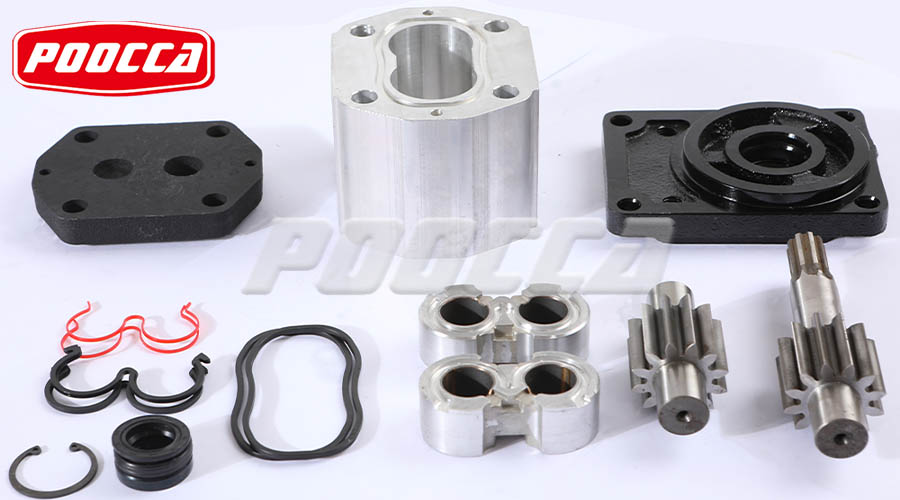
Types of Seals and Sealing Elements
| Seal / Element Type | Typical Application in Hydraulic Pumps | Primary Function |
|---|---|---|
| Rod / Shaft Seal | Around moving shaft/rod | Prevent pressurized fluid leakage along the shaft while accommodating motion. |
| Piston Seal | Sliding pistons inside chambers | Maintain pressure differential across piston and prevent internal bypass leakage. |
| O-Ring | Static joints, interfaces, and some dynamic uses | Basic seal element for static sealing and secondary dynamic sealing; versatile and widely used. |
| Wiper / Scraper Seal | At rod exits before primary seals | Remove contaminants (dirt, moisture) from rod surface to protect internal seals. |
| Wear / Guide Ring | Around piston or rod | Provide guidance and prevent metal-to-metal contact, improving seal life. |
| Back-Up Ring | With soft elastomeric seals | Prevent extrusion of soft seals into clearance gaps at high pressures. |
| Rotary Seal | Rotating shaft components | Seal fluid on rotating shafts (e.g., in gear or vane pumps). |
Seal Material Comparison — How to Pick the Right Material
Choosing the right material for seals and sealing elements in a hydraulic pump is one of the most important decisions you can make. The material determines how well a seal withstands pressure, temperature, fluid, all of which affect performance, service life and total cost of ownership. Below is a clear comparison of the most common sealing materials used in hydraulic pumps:
| Material | Typical Temp Range | Key Strengths | Typical Applications |
|---|---|---|---|
| NBR (Nitrile Rubber) | ~−30 °C to +100 °C | Good oil resistance, cost-effective, flexible | General hydraulic systems, standard O-rings & dynamic seals |
| HNBR (Hydrogenated Nitrile) | ~−40 °C to +150 °C | Better heat & abrasion resistance than NBR, strong mechanical properties | Higher duty hydraulic pumps and mobile equipment |
| FKM (Fluoroelastomer / Viton) | ~−20 °C to +200 °C | Excellent heat & ch | High-temperature or chemically aggressive systems |
| PU (Polyurethane) | ~−40 °C to +100 °C | Excellent wear/abrasion resistance, high pressure handling | Dynamic seals under heavy load and frequent cycles |
| PTFE (Tefl | ~−200 °C to +260 °C | Ultra-wide temp range, very low friction, chemically inert | Low-friction, |
How to Choose the Right Seal
-
Know your operating pressure: choose seals rated for both normal working pressure and potential pressure spikes.
-
Understand the temperature range: select materials that can tolerate the lowest and highest temperatures in your system.
-
Match seal material to hydraulic fluid: ensure the seal material is compatible with the specific fluid and additives used.
-
Choose the correct seal type for motion: dynamic seals are for moving parts, static seals are for fixed interfaces.
-
Verify precise dimensions: accurate ID/OD and groove sizing prevent leakage and fitting failures.
-
Consider wear and service life: prioritize materials with better wear resistance for high cycle or abrasive conditions.
-
Balance cost and long‑term value: higher‑performance seals may cost more initially but reduce downtime and maintenance costs over time.
-
Choose reputable suppliers: prefer seal vendors with material certifications and technical support to avoid quality issues.
Common Seal Failure Modes & Prevention
Understanding why seals fail is key to improving hydraulic pump reliability and lowering maintenance costs. Below is a breakdown of the most common failure modes with their causes and how to prevent them:
Common Failure Modes
| Failure Mode | Cause | Prevention |
|---|---|---|
| Seal Hardening / Cracking | High operating temperatures cause material to stiffen and lose elasticity. | Use heat‑resistant materials (e.g., FKM, PTFE) and control system temperature. |
| Wear & Abrasion | Friction between seal lips and mating surfaces or abrasive contaminants. | Ensure proper lubrication, surface finish and install high wear‑resistant materials like PU. |
| Improper Installation Damage | Cuts, nicks, misalignment or incorrect installation technique. | Use correct tools, lubrication during install, and precise alignment. |
| Extrusion / Fracture | Excessive pressure spikes or low‑grade material stress. | Select pressure‑rated seals and consider back‑up rings for high pressure. |
| Contamination Damage | Dust, dirt, metal particles scoring seal surfaces. | Improve filtration, keep environment clean, and use effective wiper seals. |
| Chemical Degradation | Incompatible fluid or additives attacking seal material. | Verify fluid compatibility and choose chemically resistant materials. |
| Swelling / Softening | Seal absorbs fluid it’s not compatible with. | Match seal material to fluid type and maintain fluid quality. |
| Aging & Fatigue | Long service life leads to loss of elasticity and cracking. | Regularly inspect and schedule seal replacement before end‑of‑life. |
Conclusion
Without effective sealing, fluid escapes, pressure drops, contamination enters, wear accelerates, and overall system reliability deteriorates fast. High‑quality seals help prevent leaks, maintain pressure, reduce friction, and protect internal parts, which directly improves productivity and reduces maintenance costs.
Choosing the right seal involves understanding your operating conditions (pressure, temperature, motion), matching seal material to the hydraulic fluid and environment, and ensuring correct dimensions and installation. A well‑engineered sealing solution not only extends the life of the pump but also enhances energy efficiency and system safety.
At Poocca Hydraulic (Shenzhen) Co., Ltd., we bring 20 + years of industry expertise to every hydraulic solution we deliver — from precision components like pumps and motors to complete system support. As a one‑stop hydraulic manufacturer and supplier, we integrate research and development, manufacturing, sales, and after‑sales support to meet your needs. Our product portfolio includes gear pumps, piston pumps, vane pumps, hydraulic motors, valves and accessories, all tested rigorously for quality and reliability.
Here’s why customers choose Poocca:
-
Extensive product range: With over 1,600 hydraulic product variants, you can easily find the right model for your application across construction, agricultural, industrial and mobile equipment.
-
Global quality and compliance: Our products meet international standards such as CE, RoHS and ISO, ensuring consistent performance and peace of mind.
-
Custom solutions and support: We offer OEM/ODM customization and tailored technical assistance to optimize your system designs and solve unique engineering challenges.
-
Commitment to service: Fast delivery, robust technical support and a 12‑month quality warranty help you keep your systems running smoothly.
Whether you need help selecting sealing elements for hydraulic pumps, upgrading components for higher efficiency, or sourcing complete hydraulic units, Poocca is ready to support your success — from first inquiry to long‑term operation.
Post time: Jan-22-2026


