
Introduction
The name “Bosch gear pump” often refers not merely to a product line, but to a legacy rooted in decades‑long hydraulics engineering expertise. Today’s Bosch pumps—including its renowned gear‑pump lineup—are manufactured under the banner of Bosch Rexroth, an entity formed when Mannesmann Rexroth AG merged with the automation‑technology division of Robert Bosch GmbH in 2001 — giving birth to Bosch Rexroth.
Over time, Bosch Rexroth has consolidated its position as a global leader in hydraulics, motion and control technologies, supplying components and solutions for industrial machinery, mobile hydraulics, factory automation, and more.
This article aims to provide a clear, data-driven, and objective evaluation of Bosch gear pumps: explaining their working principles, advantages, limitations, and how to objectively determine if they meet your needs. Ultimately, I hope to help engineers, system designers, and purchasing decision-makers make informed choices.
What Is a Bosch Gear Pump — Fundamental Design & Operating Principle
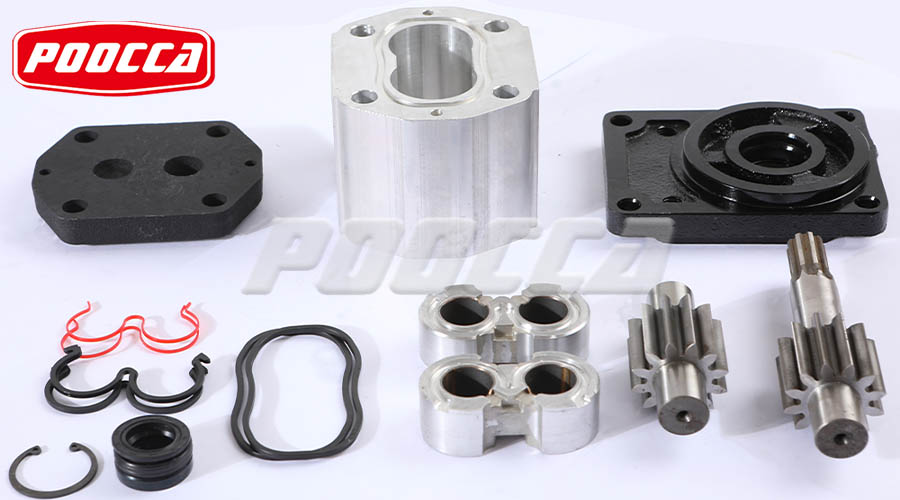
Basic Structure of a Bosch External Gear Pump
The gear pumps from Bosch Rexroth (hereafter “Bosch”) — often referred to simply as “Bosch gear pumps” — belong to the category of external (external-gear) fixed-displacement pumps.
Their basic construction consists of:
-
A casing (housing) with a “front cover” and a “rear (end) cover.”
-
Two identical external gears (gear wheels), each mounted on its own shaft. One gear is the drive gear (driven by motor or prime mover), the other is the driven (idler) gear — the drive gear meshes with and drives the idler.
-
Slide bearings (plain bearings / bearing bushings) supporting each gear shaft on both ends (front and rear covers). In Bosch pumps, slide bearings are designed for high loads and even offer good dry-running / emergency-lubrication performance at low speeds.
-
Sealing elements: a shaft seal ring for the drive shaft, and internal design to seal the fluid chambers using pressure-dependent gap sealing (i.e. the pump uses hydraulic pressure to help seal internal clearances).
Due to this relatively simple and robust architecture — only two gears, a housing, bearings and covers — external gear pumps tend to have compact size, relatively high power density, few moving parts, and relatively low manufacturing/production cost.
Because of their simple structure and fixed displacement, they also tend to have good emergency-running properties (for example, tolerating brief periods of low lubrication at startup without immediately damaging the pump).
Operating Principle — How the Pump Converts Mechanical Energy Into Hydraulic Flow & Pressure
Like all external gear pumps, a Bosch gear pump works according to the positive-displacement gear-meshing principle, converting mechanical input (torque + rotational speed) into fluid flow and pressure.
Here is a step-by-step breakdown of how fluid moves through the pump:
-
Suction (Intake) Phase
-
As the drive gear rotates, it drives the idler gear; on the suction side, as the gears rotate out of mesh, the tooth-spaces between gear teeth and the casing enlarge. This rapid increase in volume creates a partial vacuum (low pressure) inside those “cavities,” which draws fluid (e.g. hydraulic oil) from the reservoir into the pump through the suction port.
-
The fluid fills the growing volume, effectively being “trapped” between the gear teeth and the pump housing.
-
-
Transfer Phase (Carry-Over)
-
Once trapped, the fluid is carried around the outer circumference of the gears (around the housing) — from the suction side, along the outside of the gears, toward the discharge side. Importantly: fluid does not pass between the two meshing gears at the center; it follows the outer path between gear and casing.
-
This ensures a continuous, sealed carriage of fluid — minimal backflow, minimal leakage when tolerances are tight.
-
-
Discharge (Output) Phase
-
When the fluid-filled cavities reach the outlet side, the gear teeth begin to mesh again (closing the volume). This meshing reduces the volume, mechanically forcing the trapped fluid out through the discharge port under pressure.
-
Because the gear geometry and clearances are fixed, each revolution displaces a fixed volume — i.e. flow rate is proportional to rotational speed (rpm). That is why external gear pumps are “fixed displacement” pumps.
-
Because of tight clearances (gear-to-casing and gear-to-gear) and precise manufacturing, the pump can build up significant pressure and deliver hydraulic energy efficiently. Bosch’s design also uses pressure-dependent gap sealing, which leverages system pressure to improve internal sealing, reduce leakage, and enhance volumetric efficiency.
Bosch Gear Pump Product Spectrum — Series, Specs & Performance Data
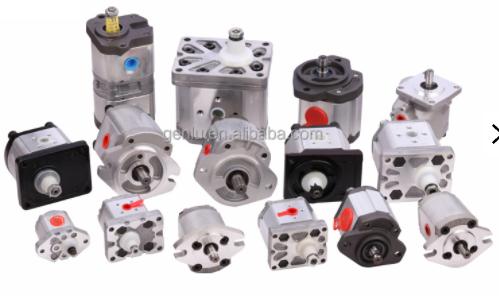
One of the strengths of Bosch Rexroth gear pumps is that they come in a well-structured product lineup, covering a wide range of displacements, pressures and configuration options — making them adaptable to many hydraulic systems.Below is a summary of the main series / platforms, plus typical specs and what they imply in practice.
Main Series / Platforms
| Series / Platform | Displacement Range (per rev) | Continuous Pressure (max) | Intermittent / Peak Pressure | Notes / Typical Use |
|---|---|---|---|---|
| AZPB (Platform B) — “High Performance / compact” | ~ 1.0 … 7.1 cm³/rev | up to 220 bar | up to 250 bar | Compact, low-displacement, suitable for small-scale hydraulics, lubrication circuits or low-flow applications. |
| AZPW (Platform F) — “Standard External Gear Pump” | ~ 4 … 22 cm³/rev | up to 190 bar | up to 210 bar | Entry-level / standard pump for medium flow / pressure applications. |
| AZPF (Platform F) — “High-Performance External Gear Pump” | ~ 4 … 28 cm³/rev | up to 250 bar | up to 280 bar | Increased displacement & pressure capability — versatile general-purpose use. |
| AZPN (Platform N) — High-Performance, larger size | ~ 20 … 36 cm³/rev | up to 250 bar | up to 280 bar | For higher flow demands, larger systems. |
| AZPG (Platform G) — High-Performance, largest range | ~ 22 … 100 cm³/rev | up to 250 bar | up to 280 bar | Heavy-duty, high-flow systems, industrial or mobile hydraulics requiring large volume flows. |
| Other variants — “SILENCE”, “SILENCE PLUS” etc. — same displacement ranges as above, but optimized for lower pulsation / noise. | — | up to 250 bar contin., up to 280 bar peak (depending on model) | — | Useful when noise, vibration or flow pulsation are concerns (e.g. mobile hydraulics, indoor machinery, sensitive environments). |
Note: “Displacement per rev” refers to geometric displacement (i.e. theoretical volume per revolution). Actual output flow also depends on rotational speed (rpm) and volumetric/mechanical efficiency — real flow will be somewhat less, depending on system conditions.
Typical Technical / Performance Parameters
To make the specifications more concrete, here are representative data from actual Bosch Rexroth units, as available in publicly-listed product catalogs:
-
Example: a pump with displacement ~ 8 cm³/rev; rated for max. operating pressure ~ 250 bar; maximum rotational speed up to ~ 4000 rpm.
-
For a 22.5 cm³/rev pump (AZPF-series), one listing shows “max flow ~ 47.0 (l/min?)” under certain conditions, with standard flange/shaft ports and standard body casting.
-
Slide / plain bearings for high load applications; shafts and flanges compliant with standard ISO or SAE, or can be customized per customer requirements.
-
Port connections — line ports can be either flanged or threaded; this offers flexibility in system integration.
-
Multiple-pump (multi-stage, multistage / tandem) configurations supported. For example, within AZPF series, through-drive configuration allows adding second or third pump stages — but technical limits apply, such as maximum transmissible torque (e.g. M_max = 65 Nm for AZPF-1x, 85 Nm for AZPF-2x) which may impose restrictions on resulting pressure or flow, depending on arrangement.
Advantages of Bosch Gear Pumps — What They Do Well
When you choose a high-quality external gear pump like those from Bosch, you benefit from a number of strong, practical advantages — many of which make gear pumps a “go-to” solution for a wide range of hydraulic and fluid handling systems.
Key Advantages
1. Stable, predictable & precise flow — even under varying conditions
Because gear pumps are positive-displacement devices, and external gear pumps generate flow proportional to rotational speed with a fixed displacement per revolution, the output flow is constant and repeatable (assuming rpm and fluid viscosity are stable).
This stability and predictability make them well suited for applications requiring accurate fluid metering, dosing, lubrication, or steady hydraulic flow — e.g. lubrication circuits, hydraulic units for machines, fluid transfer, etc.
2. Compact structure, simple design & easy maintenance
External gear pumps have relatively few moving parts — typically just two external gears, shafts, bearings, and a pump housing.
Because of this simplicity, they are often compact, space-efficient, and lightweight, making them easier to install, especially when system space is constrained.
Fewer parts also mean fewer potential failure points, which reduces maintenance complexity and cost over time — a key advantage for long-term reliability and lower lifecycle cost.
3. Good volumetric efficiency and capability with viscous fluids
Because of tight clearances and precise gear/housing machining, gear pumps can achieve high volumetric efficiency, especially when handling hydraulic fluids or oils of normal to medium viscosity.
Many external gear pumps are also versatile across a relatively wide viscosity range — making them effective for oils, lubricants, hydraulic fluids, etc.
4. Self-priming capability and good suction / dry-lift performance (within limits)
Some external gear pumps exhibit strong self-priming — meaning they can evacuate air and draw fluid in without requiring complicated priming devices or procedures, which simplifies installation and operation.
This is particularly useful in systems where the pump suction may be above the fluid reservoir, or systems prone to occasional air ingress.
5. Versatility — wide range of applications and fluids
External gear pumps (including industrial-grade ones like Bosch’s) are used in many domains: hydraulic systems, lubrication circuits, fluid transfer, metering/dosing, chemical processing, general industrial machinery, mobile hydraulics, etc.
This versatility stems from their robustness, compactness, and ability to handle typical hydraulic fluids and oils — making them a proven, trusted solution for numerous use cases.
6. Cost-effectiveness & Low Lifecycle Cost for Suitable Applications
Because gear pumps are simpler and cheaper to manufacture (fewer components, simpler machining), their upfront cost is generally lower than more complex pump types (e.g. variable-displacement piston pumps).
Combined with lower maintenance needs and reliable performance, this can translate into good value over the lifetime — especially in systems with stable, moderate pressure/flow requirements and clean hydraulic fluids.
Limitations and Common Misconceptions — When Bosch Gear Pumps May Not Be Ideal
While external gear pumps from a reputable manufacturer such as Bosch deliver many advantages, they also come with inherent limitations and trade-offs. A clear understanding of these helps engineers and buyers avoid design mistakes, extend system lifetime, and choose the right pump for the right application. Below are the main drawbacks and common misunderstandings associated with gear pumps.
Key Limitations & Risks
1. Requirement for clean, non-abrasive fluid — poor tolerance for solids or contaminants
Because a gear pump depends on tight clearances between gears and between gear teeth and the casing, any abrasive particles, dust, hard solids or contaminants in the fluid can accelerate wear dramatically. Such wear leads to increased internal leakage (slip), reduced volumetric/mechanical efficiency, pressure loss, and shortened service life.
Therefore, if the hydraulic fluid contains abrasive particles or is poorly filtered — gear pumps are generally not a good choice.
2. Fixed displacement — no built-in ability to vary flow or pressure
External gear pumps are “fixed displacement” devices: each revolution displaces a fixed volume of fluid, and flow rate is directly proportional to rotational speed.
This means that gear pumps cannot natively provide variable flow or pressure, which is a disadvantage for systems requiring adjustable flow, variable output pressure, energy saving (via flow control), or fine control. For applications needing flexibility or dynamic load response, other pump types (e.g. variable-displacement piston pumps) may be more appropriate.
3. Efficiency & performance degrade with wear, fluid condition, viscosity or temperature variation
Because efficiency depends on tight internal clearances and good sealing, factors such as wear, seal degradation, fluid contamination, or viscosity/temperature fluctuations can degrade performance. Increased clearances lead to internal leakage (“slip”), reduced flow or pressure output, higher noise, and less predictable behavior over time.
Over long-term operation, this may demand more frequent maintenance or lead to shorter service intervals.
4. Not tolerant of dry-running or insufficient lubrication / suction problems
Gear pumps generally require a continuous supply of fluid for lubrication of internal gears and bearings. If they run “dry” (no fluid) or fluid supply is interrupted (e.g. suction line issues), the metal parts may suffer direct contact, leading to premature wear or immediate damage.
Thus, gear pumps are not ideal for applications where interruption of fluid supply or frequent starts/stops are common.
5. Limited high-flow / large-volume capability; not ideal for very large systems or bulk transfer
Because individual gear pumps have a limited displacement per revolution, their maximum continuous flow rate and pressure capacity are constrained. For very high flow demand or large volume transfer, gear pumps may become inefficient or impractical.
Using multiple pumps or larger-displacement gear pumps may help, but this adds complexity and cost — and may still fall short compared to other pump types for large-scale systems.
6. Noise, pulsation, vibration and mechanical loads due to radial imbalance and internal leakage
The meshing and unmeshing of gears, combined with pressure differences inside the pump, can cause pressure pulsations, radial forces on gear shafts / bearings, noise, and vibration. In certain designs or under certain conditions (e.g. pressure fluctuations, wear, or clearance issues), these effects become more pronounced.
This may be problematic in noise-sensitive environments, precision hydraulic circuits, or systems where vibration is undesirable.
7. Limited repairability after wear / damage
Once parts (gears, bearings, housing) experience wear — especially from contaminated fluid or abrasion — restoring original performance is difficult. Tight tolerances are required. Some sources note that external gear pumps are “not easy to repair after wear,” often meaning that the entire pump or major components must be replaced rather than simply repaired.
Common Misconceptions & Improper Uses — Why “Cheap & simple = always OK” Isn’t True
-
“Gear pumps are good for anything, including dirty or abrasive fluids.” Actually, their tight clearances mean they are very sensitive to contamination and abrasive particles. Using them with dirty fluids leads to rapid wear and failure.
-
“Just pick a high-quality brand (e.g. Bosch) and you can ignore maintenance and fluid quality.” Even premium gear pumps cannot overcome fundamental limits — if fluid is contaminated, or maintenance is neglected, performance will degrade. Quality only extends lifetime when combined with proper filtration, fluid management, and maintenance.
-
“Fixed displacement pumps are always acceptable; you can control flow via motor speed or valves.” While theoretically possible, controlling flow via motor speed or throttling wastes energy, can introduce inefficiencies or heat, and may not match the smooth, efficient performance of a variable-displacement pump. Over-throttling pressure wastes energy and can cause overheating / fluid degradation.
-
“Gear pumps are cheap — so just replace when they wear out.” For large or critical hydraulic systems, frequent replacement leads to increased lifetime cost, downtime, and unpredictable maintenance — often defeating the “cheap pump” philosophy.
How to Choose — Decision Guide & Practical Advice
Choosing the right gear pump (such as a Bosch gear pump) requires matching pump characteristics to your system’s actual requirements — fluid properties, flow, pressure, duty cycle, environment, maintenance regime, etc. Here is a step-by-step decision guide and practical advice to help you select appropriately.
Step-by-Step Gear Pump Selection Guide
-
Define the fluid (medium) properties
-
Check fluid viscosity, temperature range, chemical composition, presence of solids or contaminants, abrasives, corrosive agents. As a rule: gear pumps perform best with clean hydraulic fluids (e.g. HLP mineral oil for Bosch pumps) within the recommended viscosity and temperature range.
-
If fluid is abrasive, contains solids, or is chemically aggressive — consider materials compatibility (body, seals) or avoid gear-pump solutions.
-
-
Quantify system flow and pressure requirements
-
Estimate required flow rate (e.g. in L/min or m³/h) for your system’s actuators, circuits, or lubrication/transfer needs. Then allow for a safety margin (commonly 10–20%) to account for variation or future expansion.
-
Define required operating pressure and transient/peak pressures (if system has pressure spikes). Ensure the pump’s rated working pressure (continuous and intermittent) meets or exceeds system demand.
-
-
Match pump displacement & speed to flow requirement
-
Use the formula:
Flow rate=Displacement (per rev)×Speed (rpm)×Volumetric efficiency
-
Because gear pumps are fixed-displacement, you need to choose a displacement (cm³/rev or ml/rev) and operating speed that meet your flow requirement — and check that under those conditions, volumetric/mechanical efficiency remains acceptable (e.g. 80–90%).
-
Avoid overspeed or underspeed: running too fast can increase wear, noise, risk of cavitation; too slow may fail to deliver required flow or cause poor suction.
-
-
Ensure suction, inlet plumbing and filtration are properly designed
-
Suction conditions matter: suction lift (vertical/horizontal), suction-line diameter, length, cleanliness, and inlet filter must all be appropriate. If suction lift is too high or suction line has too much resistance, pump may cavitate or fail to prime.
-
Use a sufficiently large suction-strainer or filter at inlet; ensure its open area is several times the cross-section of suction line to avoid suction vacuum or flow restriction.
-
Maintain oil cleanliness: this strongly affects pump lifetime and performance stability (internal leakage, wear).
-
-
Check material and sealing compatibility with fluid & environment
-
For standard hydraulic oil (e.g. HLP mineral oil, as recommended by Bosch), cast-iron or standard pump body is acceptable.
-
If fluid is corrosive, chemically aggressive, or temperature extremes are involved — consider special materials (stainless steel, special seals) or avoid standard external gear pumps.
-
-
Estimate required power and prime mover matching
-
Based on flow rate, displacement, pressure and efficiency — calculate required input shaft power (motor/driver), with a safety margin (often 20–30%) for reliability.
-
Ensure motor/prime mover can handle torque and speed under expected load.
-
-
Assess maintenance, serviceability and lifecycle cost
-
Prefer pumps whose wear components (gears, bearings, seals) are easy to access and replace; standardization helps with spare-parts sourcing and downtime reduction.
-
Design for preventive maintenance: clean oil, regular filter changes, inspection of clearances/seals. This helps sustain volumetric efficiency and avoid premature failure or internal leakage.
-
Summary & Quick Decision Checklist
Here is a quick checklist to help you decide if a Bosch gear pump is a good match for your system:
| ✅ Yes? / ❌ No? | Decision Suggestion |
|---|---|
| ✅ Fluid is clean, filtered, non‑abrasive | OK for gear pump |
| ✅ Flow demand is steady or moderately stable (not highly variable) | OK |
| ✅ Required pressure within gear‑pump rating | OK |
| ✅ System allows fixed displacement (no need for variable flow/pressure) | OK |
| ✅ Installation space is limited / compact pump needed | Good fit |
| ✅ Maintenance (filtering, fluid cleanliness, inspections) is feasible | Good |
| ❌ Fluid contains solids / contamination / abrasive particles | Avoid gear pump or ensure heavy filtration/clean‑up |
| ❌ Flow/pressure demand fluctuates significantly or needs high dynamic response | Consider other pump types |
| ❌ System is heavy‑duty / high‑load / long runtime under harsh conditions | Evaluate robustness — may need more heavy‑duty pump |
| ❌ Noise, cavitation, dry‑run risk, or poor suction conditions exist | Reconsider pump type or design carefully |
Conclusion: If your system checks most or all “✅” boxes above, a Bosch gear pump is likely a cost‑effective, reliable, and efficient solution. If many “❌” boxes apply, consider more robust or flexible pump types, or ensure that system design and maintenance overcome the limitations.
Call to Action (Why Contact Poocca / What We Offer)
At Poocca Hydraulic (Shenzhen) Co., Ltd., we understand fluid power systems — and we know that “off‑the‑shelf” pumps don’t always fit every application perfectly.
-
If your hydraulic system conditions (flow, pressure, fluid cleanliness, working environment) align with what gear pumps can do — we can help you select the right model (even from Bosch lineup), ensure compatibility (shaft/port standards, mounting, fluid type), and advise on installation & filtration for long-term reliability.
-
If your system conditions are more demanding (e.g. dirty fluids, high load, special fluids, custom mounting, high flow, multi-circuit) — Poocca can provide custom gear‑pump solutions (OEM/ODM) tailored to your needs, or help you evaluate whether a gear pump is the right choice.
-
We invite you to contact us for a free consultation & quote. Provide your system parameters (flow rate, pressure, fluid type, runtime, application scenario), and our engineering team will propose the optimal pump or hydraulic solution.
Post time: Dec-03-2025


